
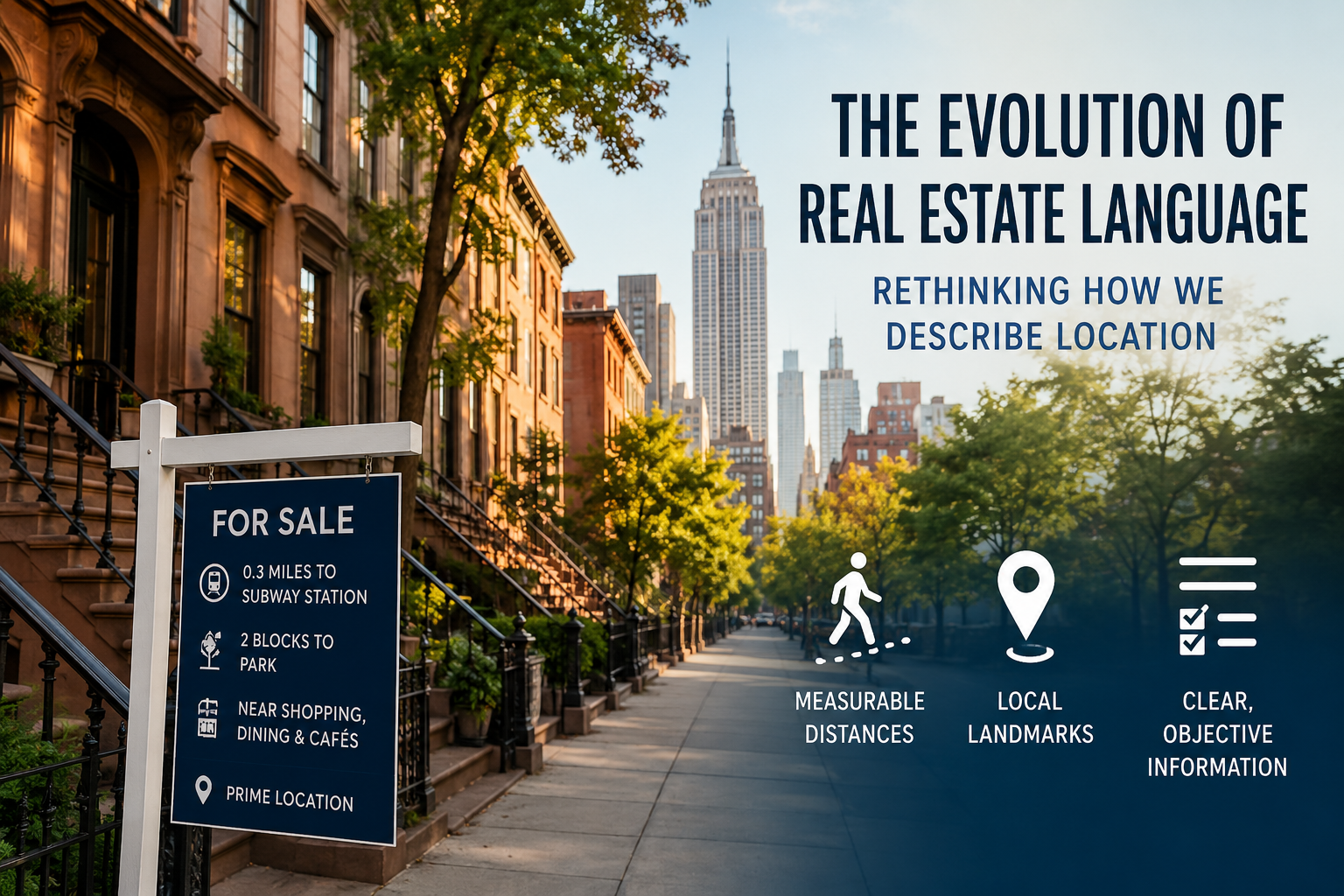
For decades, phrases like “walking distance,” “steps from the park,” and “walkable neighborhood” appeared routinely in New York real estate listings across the country. They seemed harmless. Helpful, even. Buyers wanted to understand whether a train station, grocery store, restaurant, or park was nearby, and agents used these descriptions to communicate convenience and lifestyle. Today, however, many real estate professionals are becoming more thoughtful about how they use those terms.
The reason reflects a broader shift occurring throughout the industry. Modern real estate marketing is increasingly balancing lifestyle storytelling with objective, verifiable information.
At first glance, the phrase “walking distance” sounds straightforward. In reality, it means something different to everyone.
A quarter-mile walk may feel effortless to one buyer and inconvenient to another. Age, mobility, family circumstances, personal preferences, weather conditions, and daily routines can all influence how someone experiences a neighborhood.
What one buyer considers an easy stroll, another may view as a meaningful distance.
That subjectivity is why many real estate professionals are becoming more intentional with neighborhood language. The goal is not to eliminate location-based storytelling, but to ensure buyers have accurate information that allows them to evaluate a property based on their own needs.
Rather than relying solely on lifestyle assumptions, the strongest listings increasingly focus on facts.
Instead of saying a property is “within walking distance of the subway,” an agent may note that it is located approximately 0.3 miles from a specific station. Rather than describing a home as “steps from downtown,” a listing may reference its proximity to specific streets, transit hubs, shopping districts, parks, or neighborhood landmarks.
The difference may seem subtle, but it matters.
Objective information allows buyers to determine what works best for their lifestyle. It provides context while leaving room for individual preferences and circumstances.
This shift is particularly relevant in New York City, where location is often one of the most valuable components of a property’s appeal.
In a city where a home’s neighborhood identity can be just as influential as the residence itself, language matters. A phrase like “steps from Central Park,” “near world-class dining,” or “close to transportation” can shape a buyer’s perception before they ever walk through the door.
Whether a buyer is considering an Upper East Side condominium, a Brooklyn townhouse, or a Downtown Manhattan loft, access to transportation, restaurants, parks, cultural institutions, waterfronts, and retail amenities often plays a major role in the decision-making process.
The challenge for agents is communicating those advantages accurately while allowing buyers to interpret them through their own priorities.
That distinction has become increasingly important as buyers themselves become more diverse.
Some purchasers prioritize public transportation access. Others rely primarily on cars. Some seek a lifestyle centered around exploring neighborhood amenities on foot. Others place greater emphasis on convenience, accessibility, or proximity to work.
No single phrase can capture every buyer’s experience.
The most effective listing language recognizes that reality.
Descriptions such as “approximately two blocks from the neighborhood park,” “located near the downtown dining district,” “convenient access to major transportation corridors,” or “approximately one-half mile from the waterfront” provide useful information without making assumptions about how someone lives.
Good real estate marketing informs. It does not prescribe.
This distinction extends beyond compliance. It also reflects evolving consumer expectations.
Today’s buyers have access to more information than ever before. They can research commute times, transportation routes, neighborhood amenities, schools, and local businesses independently. What they increasingly expect from real estate professionals is accuracy, transparency, and thoughtful context.
The role of an agent is no longer simply to promote a property. It is to provide the insight and information that allow buyers to make confident decisions.
That shift has elevated the importance of precision in real estate language.
The strongest marketing tells buyers where something is, not how they should feel about it. It identifies proximity without assigning assumptions. It provides context without creating limitations.
There is, of course, still a balance.
Buyers want neighborhood information. They want to understand what exists beyond a property’s walls. Restaurants, parks, cultural venues, transportation options, shopping districts, and recreational amenities remain some of the most important factors influencing a purchase.
The goal is not to remove those details from listings. The goal is to communicate them responsibly.
The line is crossed when marketing begins to imply how a buyer lives, should live, or is expected to experience a neighborhood.
Once an agent starts making assumptions about whether someone can comfortably walk a certain distance, how long a journey may feel, or what lifestyle choices they should prioritize, subjectivity begins replacing objectivity.
In today’s market, precision has become one of the most valuable skills a real estate professional can possess.
The industry’s language is evolving because buyers are evolving. Expectations are evolving. The way people research and evaluate homes is evolving.
The most effective agents understand that accurate information is not a limitation on great marketing. It is increasingly the foundation of it.
As real estate continues moving toward greater transparency, the future of listing language will likely become more factual, more measurable, and more buyer-directed.
And ultimately, that serves everyone better.